




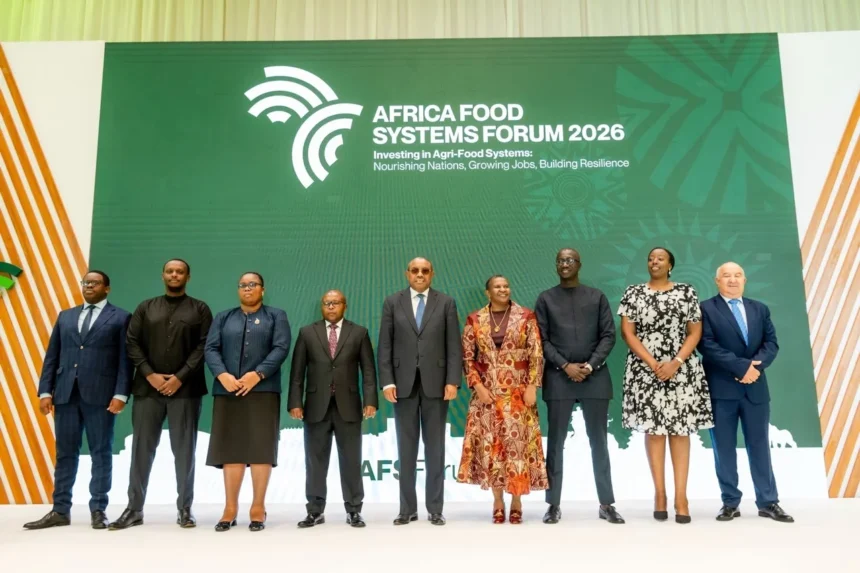

KIGALI, Rwanda — Africa has spent years announcing ambitious plans to transform agriculture. But at the 20th Africa Food Systems Forum in Kigali, the conversation is becoming increasingly direct: commitments mean little if capital never reaches the businesses, farmers and communities responsible for producing Africa’s food.
The Africa Food Systems Forum, held in Kigali from Aug. 31 to Sept. 4, brought together governments, investors, farmers, researchers, development institutions and private-sector leaders around a central theme — Investing in Africa’s Agri-Food Systems: Nourishing Nations, Growing Jobs, Building Resilience. More than 5,000 stakeholders from over 50 countries were expected to participate.
The challenge is not simply a shortage of money.
Billions of dollars are being mobilised for African agriculture and food systems, but much of that financing struggles to reach small and growing agricultural enterprises. For many businesses operating within farming, processing, storage, transport and distribution, access to affordable and appropriately structured capital remains one of the biggest barriers to expansion.
That gap between capital available and capital accessible has become one of the defining issues for Africa’s food future.
From promises to investment
The Kigali forum is designed to push African agriculture beyond declarations and toward investment that produces measurable results.
Its investment agenda focuses on blended finance, development banks, sovereign wealth, private investment and other mechanisms capable of scaling agricultural businesses and value chains. The forum’s Deal Room is intended to connect investment-ready enterprises with potential financiers and strategic partners.
The logic is straightforward: Africa cannot build resilient food systems by relying indefinitely on emergency assistance or fragmented development programmes.
It needs commercially viable agricultural enterprises capable of producing, processing, storing and moving food at scale.
That means investment must reach much further than large commercial farms.
Smallholder farmers, cooperatives, rural enterprises, food processors, logistics companies, technology firms and women- and youth-led businesses all form part of the infrastructure that determines whether food reaches consumers affordably and reliably.
The energy problem behind the food problem
One of the most important discussions in Kigali has also highlighted a challenge that is sometimes treated separately from agriculture: energy.
Reliable electricity is essential for irrigation, cold storage, processing, transport and other parts of the food chain. Without it, farmers and businesses can lose products after harvest, struggle to add value and face higher operating costs.
Experts at the forum have argued that renewable-energy investment should therefore be integrated into food-system planning rather than treated as a separate development agenda.
The implications stretch beyond agriculture.
A tomato farmer who cannot refrigerate produce, a dairy processor facing unreliable electricity or a fish trader without cold storage can all suffer losses before food ever reaches a consumer.
Investment in energy, therefore, can become investment in food security.
Africa’s biggest opportunity may be its own market
The forum is also placing greater emphasis on value addition and intra-African trade.
Rather than exporting agricultural commodities and importing processed food, African countries increasingly want to build regional value chains that allow more economic value to remain on the continent.
Livestock is one example. Agriculture and livestock ministers from several African countries have been discussing stronger regional livestock value chains, increased investment and expanded trade.
The wider opportunity is enormous.
Africa’s agricultural transformation is not only about producing more food. It is about building the businesses that process that food, the infrastructure that moves it, the financial institutions that support producers and the markets that connect them.
Climate change makes the investment question urgent
Africa’s food systems are also confronting increasingly severe climate pressures.
Droughts, floods, changing rainfall patterns, soil degradation and extreme temperatures are raising risks for farmers whose livelihoods depend heavily on predictable weather.
That makes climate resilience a financial issue as much as an environmental one.
The forum has therefore placed climate resilience alongside investment, food security, youth innovation and trade as interconnected pillars of agricultural transformation.
For investors, the question is increasingly whether capital can help agricultural businesses withstand shocks while remaining commercially sustainable.
Young Africans are part of the answer
Africa’s agricultural transformation will also depend on whether young people see food and agriculture as industries of the future rather than sectors associated primarily with subsistence farming.
Technology is changing that equation.
Digital agriculture, financial technology, artificial intelligence, data services, mechanisation and modern logistics are opening opportunities for young entrepreneurs to participate across the food value chain.
The Kigali agenda specifically identifies youth and digital innovation as a major investment pillar, alongside value addition and regional markets.
But innovation alone will not be enough.
Startups and rural enterprises still need access to capital, markets, infrastructure and predictable policy environments.
The real test begins after Kigali
The Africa Food Systems Forum has succeeded in putting agricultural finance at the centre of the continental conversation.
But the harder question begins after delegates leave Kigali.
Can governments create policies that reduce investment risk? Can banks develop products suitable for agricultural businesses? Can development finance be used strategically to unlock private capital? Can investors reach smaller enterprises rather than concentrating funding among the largest players?
And perhaps most importantly: can African countries turn investment pledges into productive assets on farms, in rural businesses and throughout food supply chains?
The stakes extend far beyond agriculture.
Food security affects inflation, employment, public health, political stability, trade and economic growth. A stronger African food system could create millions of opportunities while reducing the continent’s vulnerability to external shocks.
Kigali’s message is therefore bigger than agriculture.
Africa does not simply need more money for food systems. It needs capital placed where it can produce food, create jobs, build resilience and generate lasting economic value.
That is where the success or failure of Africa’s next agricultural transformation will ultimately be measured.