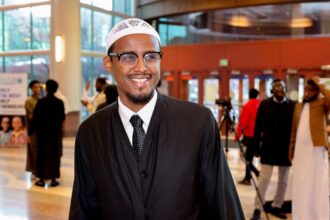
When Ali Abdulla learned that his nonprofit, the African Youth Sports Academy, had been awarded 20 free tickets to a FIFA World Cup Round of 16 match in Seattle next month, he described it as one of the happiest moments of his life.
For many of the young people in his program—children from low-income and immigrant families—the opportunity was extraordinary. With World Cup ticket prices approaching $1,000, attending a match of this magnitude would have been an experience many could only dream of.
But that excitement quickly turned into disappointment.
The turning point came when Omar Artan, the first Somali referee ever selected to officiate at a FIFA World Cup, was denied entry into the United States after arriving in Miami. Artan, who had been issued a visa and was set to make history for Somalia, was later removed from the tournament by FIFA.
Abdulla, a former semi-professional soccer player and Somali refugee, initially considered stepping down from his role as a volunteer FIFA ambassador in protest. However, after speaking with parents and coaches connected to the academy, a more significant gesture emerged.
“They all sent messages saying, ‘We feel heartbroken. We feel betrayed,’” Abdulla told The Associated Press. “We didn’t feel right celebrating while the only person in our country’s history selected to referee the World Cup was experiencing pain and disappointment.”
The response from families deeply moved him.
“I felt emotional when the parents suggested returning the tickets,” he said. “Giving up a once-in-a-lifetime opportunity in solidarity with one of our own made me proud to lead this organization.”
The tickets were part of a larger community initiative that distributed 1,400 complimentary World Cup tickets through a partnership between Seattle Mayor Katie Wilson’s office and the local FIFA World Cup organizing committee. Abdulla had attended the program’s launch and even recruited local youth to appear in promotional videos supporting the initiative.

He said receiving the tickets initially felt like “the best news I ever had.” The academy, which provides youth sports, mentorship, and community support services, had planned a soccer competition to determine which participants would receive the tickets. The goal was to send approximately a dozen young athletes, ages 13 to 16, along with several parents, to the match.
Instead, the organization chose to return all 20 tickets.
“The kids are very sad and heartbroken,” Abdulla said. “But we have to teach them to stand up for what is right.”
Artan’s case has attracted international attention. Somalia is among nearly 40 countries whose citizens face travel restrictions under the Trump administration’s immigration policies. According to reports, Artan was detained and questioned for 11 hours at Miami International Airport before being denied entry. U.S. officials reportedly alleged connections to terrorist organizations but did not publicly provide evidence to support the claim.
Despite the setback, Artan returned to Somalia to a warm welcome from supporters. His standing in international soccer remains strong. On Thursday, UEFA appointed him as the referee for the UEFA Super Cup match scheduled for August 12.
Seattle officials and the local FIFA World Cup organizing committee declined to comment on the academy’s decision but confirmed that the returned tickets were reassigned to another community organization, the Somali Health Board, which also sponsors youth soccer programs.
The African Youth Sports Academy’s decision was first reported by The Seattle Times.
For Abdulla, soccer has always been about more than competition. By day, he works as a transit security officer for Seattle’s light rail system. Before retiring from competitive play in 2017, he played with the semi-professional Seattle Somali Stars and remained deeply involved in community sports initiatives.
Although he had planned to serve as a volunteer World Cup ambassador—helping fans navigate Seattle and welcoming visitors to the city—he now says he will not watch the tournament at all.
Instead, his attention is focused on another event close to his heart: the 28th Annual Somali Week Tournament, scheduled for August in Kent, Washington. The event will bring together teams from across North America and Europe, including participants from Canada, the United Kingdom, Minneapolis, and other communities.
For Abdulla, the tournament represents the true spirit of soccer—bringing people together across cultures, backgrounds, and borders.
“Soccer unites people,” he said, and the decision to return the tickets was ultimately about standing together as a community when one of its members needed support the most.