




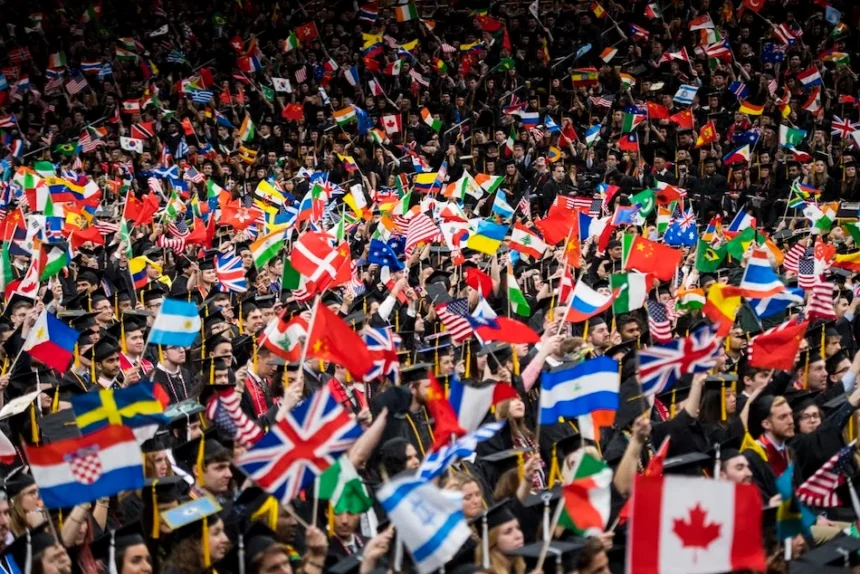

WASHINGTON — The United States could lose as much as US$3.4 billion in economic activity and nearly 40,000 jobs next academic year if the projected decline in international student enrollment materializes, according to a new analysis by NAFSA: Association of International Educators and JB International.
The projected decline is more than an education story. It is emerging as a potential economic warning for a country that has spent decades attracting students from virtually every region of the world.
The analysis estimates that as many as 111,000 fewer international students could enroll at U.S. colleges and universities during the 2026–27 academic year. International students contributed an estimated $41.77 billion to the U.S. economy in the previous academic year; that figure could fall to about $38.37 billion under the report’s higher-decline scenario.
Visa uncertainty is changing the calculation
The decline comes amid major changes to U.S. immigration and visa policies.
Students considering American universities are facing greater uncertainty over visa processing, travel restrictions and rules governing how long international students can remain in the country.
The U.S. government has also introduced restrictions affecting nationals of dozens of countries, while changes to student immigration rules could create additional difficulties for students in lengthy degree programs, particularly doctoral students.
For students and their families, those uncertainties can influence a decision that involves hundreds of thousands of dollars and several years of their lives.
Increasingly, some are asking whether studying in the United States remains worth the financial and immigration risks.
The competition for global talent is intensifying
The United States is not competing only with other American universities.
Canada, the United Kingdom, Australia, Germany and other countries are aggressively seeking international students, researchers and highly skilled graduates.
International students are valuable to universities because they bring tuition revenue, but their economic contribution extends far beyond campus.
They rent apartments, buy food, use transportation, purchase goods and services and support businesses in university communities.
When those students disappear, the economic impact spreads beyond universities.
NAFSA’s analysis estimates that the projected decline could put approximately 39,000 U.S. jobs at risk.
Africa is also feeling the shift
The changing environment is particularly significant for students from Africa.
Recent application data show that international applications from Africa have fallen sharply, with some countries experiencing particularly large declines. Common App data for the 2025–26 admissions cycle showed international first-year applications from Africa falling 17%, while applications from Asia declined 11%.
For many African families, studying in the United States represents a major investment. Tuition, accommodation, travel and living expenses can require substantial family savings, scholarships or financial support from relatives abroad.
When visa policies become unpredictable, students may increasingly consider universities in countries perceived as offering more stable pathways.
Universities could feel the pressure
The financial consequences may be especially serious for universities that depend heavily on international enrollment.
The NAFSA analysis says graduate-level enrollment declines are a major driver of the projected economic losses, particularly at institutions with large international student populations. Applications to U.S. doctoral programs have also fallen substantially.
Universities facing lower international enrollment could be forced to reconsider recruitment strategies, scholarships, graduate assistantships and other programs designed to attract foreign students.
Some communities could also lose an important source of local spending.
A bigger question for America
The immediate financial loss is measurable.
The longer-term cost is harder to calculate.
International students have historically been an important pipeline for American universities, research institutions, technology companies, hospitals and other industries.
Many graduates remain in the United States after completing their studies, contributing skills and expertise to the American economy.
If fewer of the world’s brightest students choose the United States, competitors could benefit.
That is why education leaders are warning that immigration and visa policy could affect America’s position in the global competition for talent.
Fanta Aw, CEO of NAFSA, said the projections demonstrate that U.S. policies influence where international students decide to invest their futures — with consequences for American society and the economy.
The global education map could be changing
The United States remains one of the world’s most attractive destinations for higher education. But reputation alone may no longer be enough.
Students increasingly have choices.
If uncertainty surrounding American visas and immigration rules continues, universities elsewhere could capture students who once would have automatically applied to U.S. institutions.
For Washington, the issue is therefore bigger than a projected $3.4 billion loss.
It is about whether the United States can maintain its position as a preferred destination for the world’s students, researchers and future professionals.
And for students around the world, the question is becoming equally important:
If America becomes harder to enter, where will the world’s next generation of talent choose to study?




![Achraf Hakimi of Morocco, left, and Sadio Mane of Senegal, right, are the respective star names for their nations in the 2025 AFCON final [Catherine Ivill and Ryan Pierse/Getty Images]](https://yesbriefs.com/wp-content/uploads/2026/06/Screenshot_18-330x220.png)