





GARISSA, Kenya — For residents of Garissa, getting a national identity card is supposed to be a straightforward step toward accessing everyday services and exercising basic civic rights.
But for some applicants, the wait now stretches to six or seven months.
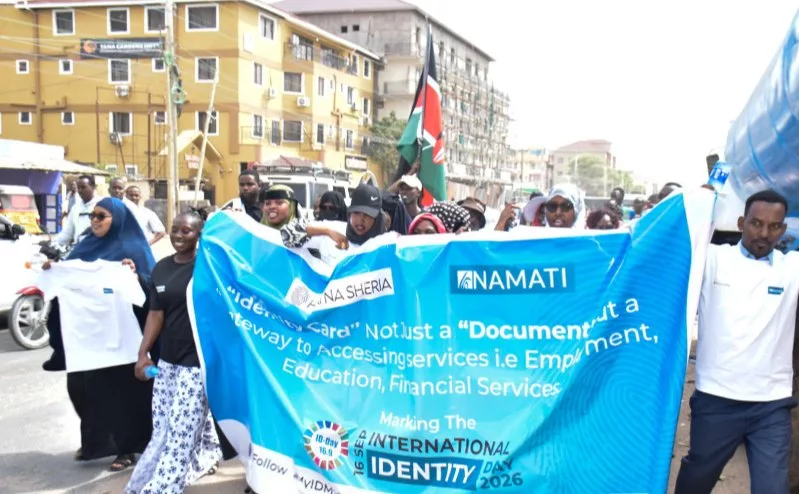
That is the concern raised by human rights activists in Garissa this week, as residents, local administrators and civil society groups gathered to mark the International Day of Identity.
The gathering came at a moment of transition for identity registration in northern Kenya. The government’s decision to remove the additional vetting requirement for ID applicants was welcomed by rights groups as an important step toward addressing longstanding barriers faced by residents of the region.
Now, activists say, a different problem is emerging: the system is struggling to process the growing number of applications. (The Star)
‘We are still waiting’
Barre Aden, programme manager at Garissa-based Haki Na Sheria, said removing vetting had made the process easier for residents.
But he said the gains risk being undermined by delays in processing and the limited number of places where residents can register or collect their documents.
Garissa is a large county, and according to Aden, only Garissa and Ijara sub-counties currently have fully functional offices serving these needs.
For people living far from those centres, accessing the service can mean travelling considerable distances—and potentially making the journey more than once.
The problem is particularly pressing for young people seeking their first identity cards.
Aden said some applicants are waiting six to seven months for their documents, raising concerns as Kenya approaches the next general election. (The Star)
The backlog behind the numbers
Government officials acknowledge that demand has increased since the vetting requirement was removed.
Mohamed Mohamud, the assistant county commissioner in charge of Garissa Huduma Centre, said there are currently 4,110 identity cards awaiting collection at the centre.
He attributed part of the backlog to the sharp increase in applications.
The government has introduced live-capture registration units across the county’s sub-counties and is using chiefs and other National Government Administration Officers to help distribute completed cards and notify applicants. (The Star)
The numbers point to a complicated picture.
More residents are applying for IDs because one of the major historical barriers has been removed. But the infrastructure needed to process those applications has not necessarily expanded at the same pace.
That leaves residents caught between a policy that has become more accessible and a system that is struggling with the resulting demand.
A long history behind a simple card
For many people in northern Kenya, the national ID has never been merely a piece of plastic.
For years, applicants from the region faced additional scrutiny through the vetting system. Applicants could be required to appear before vetting committees, provide additional documentation and satisfy conditions that were not routinely imposed on applicants elsewhere in the country. (The Star)
The removal of that additional vetting was therefore significant.
Haki Na Sheria says it addressed part of the historical inequality surrounding access to citizenship documentation.
But activists now want the government to ensure that the next stage of the reform is felt on the ground.
That means more registration centres, faster processing and fewer months spent waiting.
The election connection
The timing adds another dimension.
A national ID is required for voter registration, meaning someone who has completed the application process but is still waiting for their document may face an additional hurdle if they want to register as a voter.
Garissa leaders raised similar concerns in March, warning that slow issuance of IDs could affect thousands of residents ahead of the electoral cycle. (The Star)
The issue is therefore not simply about administrative efficiency.
It is also about whether residents can obtain the documentation they need to participate fully in public life.
The government says it is responding
Officials say they are not ignoring the backlog.
Mohamud said the government is using local administrative structures to get completed IDs to their owners. Chiefs are helping distribute documents, while applicants are being notified when their cards are ready.
He also said the government has introduced live-capture units across the county to improve the quality and accuracy of information collected during registration. (The Star)
At the national level, Parliament was told in June that the National Registration Bureau had processed and issued more than 234,000 ID cards across Garissa, Wajir and Mandera between January 2023 and March 2026. The government also reported that more than 24,000 applications from the region remained at various stages of processing at headquarters at that time. (Parliament of Kenya)
What happens after vetting?
The changes in northern Kenya show that removing a barrier does not automatically resolve every obstacle.
The question for residents now is increasingly practical: How long should someone have to wait for an identity document after completing the application process?
For Fatuma Ahmed, a Garissa human rights activist, the answer is tied to whether the reforms actually change people’s experience.
If the government has removed one form of hardship, she argued, residents should not simply encounter another one in its place. (The Star)
In Garissa, that distinction is becoming increasingly visible.
The vetting era may be over. But for thousands of applicants still waiting for their cards, the journey to possessing a national identity document is far from finished.
Source: The Star — Garissa activists decry delays in ID card applications