







A deepening trade confrontation between the United States and Canada is threatening to reshape one of the world’s most important economic relationships, after President Donald Trump demanded that Canadian leaders “fall in line” while Ottawa moved to retaliate against sweeping new U.S. tariffs.
The dispute has rapidly escalated from a disagreement over trade policy into a broader confrontation over economic sovereignty, industrial policy and the future of North America’s deeply integrated economy.
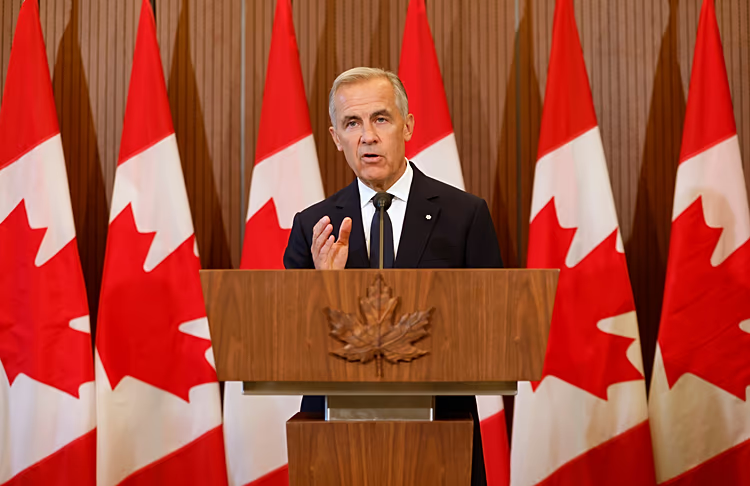
Canada has already imposed retaliatory tariffs following Washington’s decision to place 50% tariffs on a range of Canadian imports, after trade negotiations between the two countries collapsed. Prime Minister Mark Carney accused the United States of attempting to subordinate Canada and warned that Ottawa would not accept an arrangement in which Canada was treated as a “subsidiary” of its southern neighbor.
Trump, meanwhile, has threatened additional tariffs, including a proposed 50% levy on Canadian vehicles and auto parts, intensifying pressure on one of Canada’s most important industries.
A trade relationship under unprecedented pressure
The United States and Canada have one of the world’s most interconnected economies.
Factories on both sides of the border rely on components, energy, raw materials and consumers from the neighboring country. The automotive industry is particularly integrated, with vehicles and parts crossing the border multiple times during the manufacturing process.
That means tariffs imposed by one country do not necessarily hurt only the other side.
They can raise costs for manufacturers, suppliers and consumers in both economies.
The latest dispute is already creating uncertainty for automakers. Toyota and Honda, which manufacture a significant portion of their North American vehicles in Canada, could face major disruptions if the proposed U.S. vehicle tariffs take effect.
Canada chooses retaliation
Ottawa’s response reflects a growing willingness to confront Washington rather than simply negotiate over individual tariff rates.
Canadian officials have indicated that retaliation could be more targeted, focusing on products and industries where tariffs would create maximum economic pressure while protecting Canadian businesses and workers.
Canada has also signaled that it may look beyond traditional dollar-for-dollar retaliation as it searches for ways to reduce its vulnerability to U.S. trade policy.
The confrontation has therefore moved beyond a simple tariff dispute.
It is becoming a debate about whether Canada should reduce its economic dependence on the United States.
Why the world is watching
The dispute matters internationally because Canada is not just another U.S. trading partner.
It is a major supplier of energy, minerals, agricultural products, manufactured goods and other commodities to the American economy.
Any prolonged disruption could ripple through global supply chains.
Higher costs for Canadian exports could affect American manufacturers. Retaliatory tariffs could raise prices for Canadian consumers. Businesses could delay investment as they wait to see whether the confrontation becomes permanent.
Financial markets and international companies are also watching closely because the dispute could influence how other countries respond to Washington’s increasingly aggressive use of tariffs.
If Canada succeeds in expanding alternative trading relationships, other U.S. allies could become more willing to pursue similar strategies.
A warning to America’s other trading partners
The dispute is also being interpreted as a test of the Trump administration’s broader approach to international trade.
Washington has increasingly used tariffs as leverage to pressure trading partners into changing economic and political policies.
For countries around the world, the question is whether the strategy will produce new trade agreements — or encourage governments to diversify away from the United States.
Canada is particularly important because it is one of America’s closest allies.
If even the U.S.’s largest trading partner concludes that its economic security requires greater independence from Washington, the consequences could extend well beyond North America.
The risk of a prolonged trade war
Neither side appears eager to back down.
Canada wants to protect its industries and demonstrate that it will defend its economic interests. Trump has made clear that he believes tariffs give Washington leverage over its trading partners.
That creates a dangerous cycle: higher U.S. tariffs lead to Canadian retaliation, which can prompt further American measures, followed by additional Canadian responses.
Businesses ultimately pay the price.
Canadian exporters could lose access to their largest market, while American companies could face higher input costs and reduced access to Canadian products.
Consumers on both sides could eventually feel the impact through higher prices.
For the global economy, the Canada-U.S. confrontation is another warning that the era of relatively predictable international trade is becoming increasingly uncertain.
The question now is whether Ottawa and Washington can find a way back to negotiations — or whether the world’s longest undefended border will become the center of a prolonged economic battle.
For Canada, Carney’s message is clear: economic cooperation with the United States remains important, but Ottawa says it will not accept pressure to surrender its economic sovereignty.
For Trump, the message is equally forceful: Canada must change course or face greater economic pressure.
The next moves from both governments could determine whether this becomes another temporary tariff dispute — or the beginning of a fundamental restructuring of North American trade.