






The United States has carried out its first publicly confirmed military strike against Iran in a month, reigniting direct hostilities between Washington and Tehran and raising fears that a prolonged conflict could once again spiral across the Middle East.
U.S. forces struck two Iranian rocket launchers on Larak Island, in the strategically vital Strait of Hormuz, on Sunday. U.S. Central Command said Iranian forces were preparing to launch rockets carrying sea mines into the waterway, posing what Washington described as an imminent threat to commercial shipping.
Iran quickly retaliated.
Iranian state television broadcast footage of ballistic missiles being launched toward U.S. military positions in Jordan. Jordanian authorities said they intercepted eight missiles that entered the country’s airspace.
The exchange marks the most significant military escalation between the two sides in weeks.
A fragile lull comes to an end
The last publicly acknowledged U.S. attack on Iranian targets occurred on July 29, when American forces carried out strikes against dozens of Islamic Revolutionary Guard Corps targets.
Since then, Washington had increasingly shifted toward economic pressure, with the Trump administration expanding sanctions and pursuing measures intended to isolate Iran economically rather than launching additional major attacks.
That strategy has now been disrupted.
The U.S. says Sunday’s operation was limited and defensive, designed to prevent Iran from placing new mines in one of the world’s most important commercial waterways.
Iran, however, described the attack as a deadly provocation and warned that Washington would face consequences.
Why the Strait of Hormuz matters
The location of the strike is crucial.
The Strait of Hormuz is one of the world’s most important energy corridors. A significant share of global oil normally passes through the narrow waterway, meaning any sustained disruption can quickly affect fuel prices, shipping costs and inflation around the world.
Commercial traffic has already fallen dramatically during the conflict.
Before the war, roughly 130 vessels a day passed through the strait. U.S. officials say only a fraction of that traffic is currently moving through the waterway.
Oil markets reacted immediately to the renewed fighting. Brent crude rose almost 2% following the U.S. strike, reaching close to $90 a barrel.
Global economic risks are growing
The consequences extend far beyond Iran and the United States.
A prolonged disruption of the Strait of Hormuz could raise the cost of fuel for motorists, airlines, shipping companies and manufacturers across the world.
Higher energy costs can also feed into food prices and inflation because transportation and production become more expensive.
Developing economies that depend heavily on imported fuel could be particularly vulnerable.
For governments already struggling with high living costs, another sustained energy shock could place additional pressure on households and businesses.
Iran still has leverage
Despite months of military pressure, Iran retains significant ability to disrupt maritime traffic.
The country possesses missiles, drones and naval capabilities that can threaten ships and infrastructure throughout the Gulf.
The U.S. says it has been working to clear mines and protect international shipping routes. Iran, meanwhile, continues to assert that it has the authority to regulate access through the waterway under its own interpretation of agreements governing the strait.
That competing interpretation creates a dangerous environment for commercial vessels.
A further attack on shipping could push insurance costs higher and discourage more companies from sending vessels through the region.
The danger of a wider war
The immediate concern is whether the latest exchange remains limited or develops into another cycle of attacks and retaliation.
Iran has already demonstrated that it can respond by targeting U.S. military positions elsewhere in the region.
The United States has thousands of troops stationed across the Middle East, meaning an attack that kills or seriously injures American personnel could trigger a much larger response.
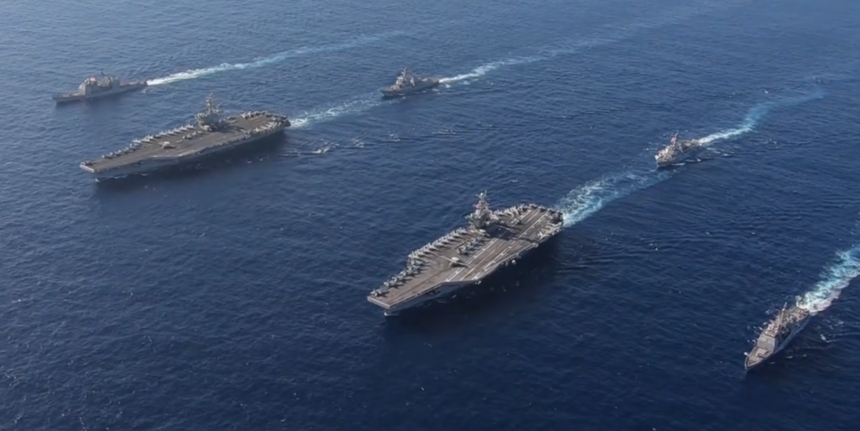
The conflict has already placed enormous demands on U.S. military resources. American commanders have reportedly raised concerns about the sustainability of maintaining such a high operational tempo while preserving readiness for other global threats.
Diplomacy faces another test
The latest escalation comes at a particularly sensitive moment.
Washington has recently emphasized sanctions and economic pressure as its preferred means of forcing Tehran to make concessions. But the return to direct military action demonstrates how quickly the situation can deteriorate.
Neither side appears ready to completely abandon its position.
The United States wants to prevent Iran from threatening shipping and maintain pressure on Tehran.
Iran wants to preserve its military and political leverage while resisting what it considers American aggression.
The result is a dangerous stalemate.
For the rest of the world, the immediate concern is simple: what happens next?
If the fighting remains limited, diplomatic channels may still have room to reopen.
If Iran responds with additional attacks — particularly against American forces or commercial shipping — Washington could face pressure to launch a much larger military response.
And if the Strait of Hormuz becomes a sustained battlefield, the consequences will not remain confined to the Middle East.
They could reach every major energy market, shipping route and economy connected to the global system.
The latest strikes have therefore ended more than a month of relative calm. They have also revived the question that has shadowed the conflict from the beginning:
Can the United States and Iran step back from the brink before another exchange of fire becomes a much larger war?