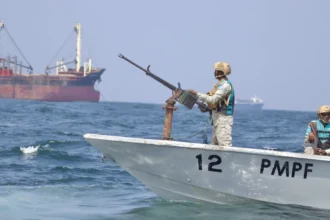






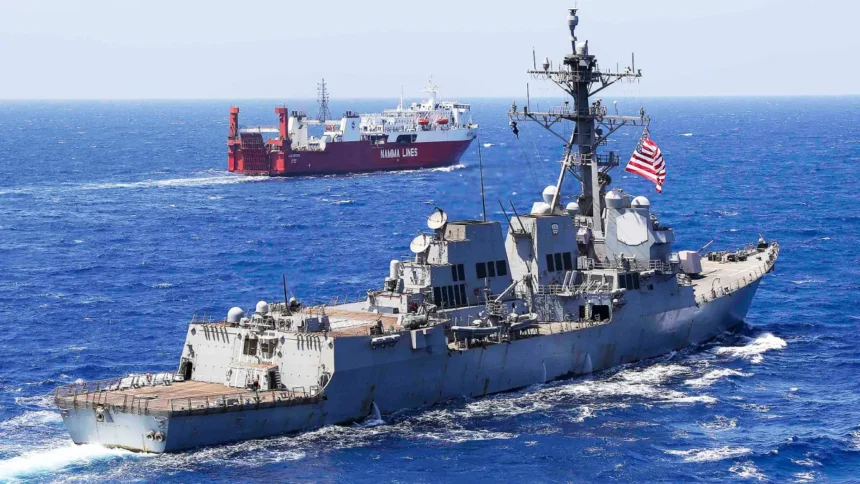

WASHINGTON — A growing threat to shipping in the Red Sea could push the United States toward a major rethink of its strategy in the Horn of Africa, as Iran-backed Houthi forces increase pressure on vital maritime routes and Saudi-linked vessels.
The Houthis have threatened and claimed attacks against Saudi oil tankers in the Red Sea after declaring a maritime blockade on Saudi Arabia. The developments have raised concerns that the group could create another major choke point for global energy supplies at the same time that Iran’s confrontation with the United States is threatening shipping through the Strait of Hormuz.
The Bab el-Mandeb Strait, which connects the Red Sea to the Gulf of Aden, is one of the world’s most important maritime passages. Any sustained disruption could force commercial vessels to take longer routes around Africa, increasing transportation costs and putting additional pressure on global energy markets.
Analysts say the escalating threat could have consequences far beyond Yemen.
Somaliland emerges as a potential strategic partner
One of the most significant possibilities being discussed in Washington is a closer relationship with Somaliland, whose location along the Gulf of Aden gives it strategic importance for monitoring maritime traffic and responding to threats from Yemen.
Analysts cited by Fox News argue that the deteriorating security environment could cause U.S. policymakers to reconsider their longstanding reliance on Djibouti as the principal American military hub in the region.
Somaliland’s Berbera port and airfield sit across the Gulf of Aden from Yemen, giving the territory a potentially valuable position for maritime surveillance, logistics and regional security operations.
The growing Houthi threat could therefore strengthen arguments inside Washington for deeper security cooperation with Somaliland.
A second maritime crisis?
The concern is that the Red Sea could become another major pressure point in an already destabilized Middle East.
The Houthis have demonstrated their ability to threaten commercial shipping, while Saudi Arabia has increasingly taken steps to conceal the movement of some oil shipments from public tracking systems because of fears of attack. Reuters reported that some tankers carrying Saudi crude are now sailing without publicly visible tracking signals.
That uncertainty makes it harder for markets and governments to determine how much oil is actually moving through the Red Sea.
The stakes are particularly high because the crisis comes as the United States is already heavily engaged in the wider confrontation with Iran.
A renewed Houthi campaign could therefore stretch American military resources even further.
Washington faces difficult choices
The United States has previously conducted extensive airstrikes against Houthi targets in Yemen in an effort to protect international shipping. A Pentagon assessment later found that the 2025 campaign killed 153 civilians and wounded 243, highlighting the risks of another large-scale military intervention.
Washington now faces a complicated choice.
It could increase military pressure on the Houthis, strengthen regional partners or pursue a broader diplomatic strategy aimed at preventing the Red Sea from becoming another front in the conflict with Iran.
Each option carries risks.
A major new U.S. military campaign could deepen the conflict in Yemen, while limited action could leave commercial shipping vulnerable.
The Horn of Africa could become more important
The latest developments could also elevate the strategic importance of the Horn of Africa.
With the Red Sea becoming increasingly contested, locations along the African side of the Gulf of Aden could become critical to U.S. and allied efforts to monitor maritime traffic and counter threats emanating from Yemen.
For Somaliland, that could create an opportunity to strengthen its international strategic relevance.
For Somalia and neighboring countries, however, a deeper U.S. military presence in the region could bring new geopolitical tensions.
The coming months could therefore determine whether the Houthi threat remains primarily a Yemen-based security problem — or becomes the catalyst for a major American realignment across the Horn of Africa and the Red Sea.
And if attacks on shipping continue, Washington may have little choice but to reconsider where and how it projects power in one of the world’s most strategically important waterways.