






KAMPALA, Uganda — Uganda’s increasingly close security relationship with Israel is facing new scrutiny after leaked documents revealed details of multimillion-dollar military deals involving surveillance drones, intelligence equipment and other systems supplied by Israeli defense giant Elbit Systems.
The disclosures come at a particularly sensitive moment for Uganda.
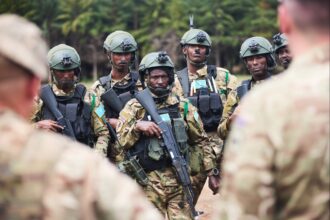
Kampala is preparing for a possible role in a proposed international stabilization force in Gaza, a move that has already raised questions about Uganda’s military relationship with Israel and the reasons behind its decision to participate.
Documents reviewed by investigative outlet Drop Site News reportedly show that the Israeli company has spent years helping Uganda expand its military drone capabilities, including equipment intended for Uganda’s Military Intelligence and Special Forces Command.
The revelations offer a rare glimpse into a security relationship that has largely operated away from public scrutiny.
A $52 million drone contract
At the center of the disclosures is a March 2024 agreement valued at about $52.1 million, according to the leaked documents.
The contract covered four Hermes 900 surveillance aircraft, along with ground systems and supporting equipment, the reports said. The documents also indicate that about $14.2 million had already been paid to Elbit in 2021.
The documents suggest the relationship began years earlier.
According to the leaked records, Elbit supplied Uganda with a refurbished Hermes 450 system in 2019, followed by additional systems in 2020 and 2021. Later agreements involved Hermes 900 aircraft, upgrades to command and communications systems and infrastructure needed to operate the drones.
The equipment was reportedly designated for Uganda’s Military Intelligence and Special Forces Command.
That detail is significant in a country where questions over the use of security technology and the role of intelligence agencies have periodically drawn public concern.
From surveillance to weapons
The leaked archive reportedly goes beyond surveillance aircraft.
Documents described by Drop Site News include references to SkyStriker, an Elbit loitering munition, as well as preparations for weapons-drop testing involving Lizard 3, a laser-guidance system designed to convert conventional bombs into precision-guided weapons.
The disclosures do not by themselves establish how or where such systems were ultimately used.
But they indicate that Uganda’s military cooperation with Israel may have involved more than simply purchasing surveillance technology.
They also show how a relationship that has historically been described in broad terms as defense cooperation has evolved into a sophisticated military-technology partnership.
Kampala and Tel Aviv have made the relationship official
The military relationship is not itself a secret.
Uganda and Israel signed a memorandum of understanding on defense cooperation in September 2022, according to Uganda’s Ministry of Defence and Veteran Affairs.
The agreement renewed and strengthened existing cooperation in defense and security matters between the two countries.
Ugandan officials have also previously acknowledged Israeli involvement in border-security and surveillance technology.
A 2022 report by Uganda’s Monitor said the defense cooperation agreement included a component covering border-management security systems.
What the leaked documents appear to add is a much more detailed picture of the scale, cost and technological sophistication of the relationship.
Why the timing matters
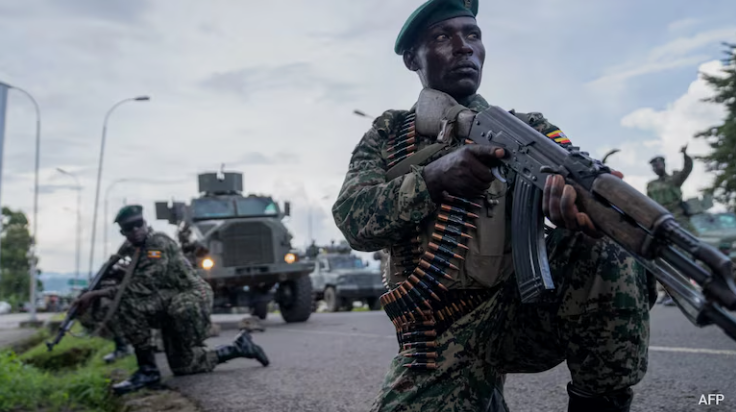
The disclosures come as Uganda considers sending troops to Gaza.
Uganda’s Parliament approved a government proposal last month authorizing the deployment of Ugandan soldiers as part of a proposed international stabilization mission.
Defense Minister Kiryowa Kiwanuka told lawmakers that President Yoweri Museveni was prepared to deploy troops, while questions remained over the precise role the Ugandan military would play and the terms under which it would operate.
That decision has placed Kampala’s relationship with Israel under a brighter spotlight.
Opposition lawmakers have questioned the government’s intentions, including what role Ugandan forces would actually have in Gaza and whose interests they would be expected to protect.
Against that backdrop, evidence of a years-long Israeli program to equip and train elements of Uganda’s military is likely to attract renewed attention.
A relationship with deep roots
Uganda and Israel have maintained military and security links for decades, although the relationship has changed considerably under different governments.
Historical records have documented Israeli involvement with Ugandan military actors during periods of political upheaval, while more recent cooperation has focused heavily on technology, intelligence and security.
Uganda’s military has also acquired Israeli-made weapons and surveillance technologies through various channels over the years.
In 2022, Monitor reported on earlier disclosures concerning Uganda’s acquisition of Pegasus spyware from Israeli company NSO Group and Israeli weapons exports to Uganda dating back decades.
The latest documents therefore appear less like an isolated transaction and more like another chapter in a long-running security partnership.
Questions about secrecy
The biggest issue raised by the new disclosures may not be whether Uganda has purchased Israeli military technology.
It is how much of the relationship has been publicly disclosed — and how decisions over expensive military systems are made.
Defense procurement is often conducted behind closed doors because of legitimate national-security concerns. But large contracts involving public money can also raise questions about oversight, procurement procedures and accountability.
The leaked documents offer details that would ordinarily be difficult for the public to obtain.
They reportedly came from an archive of hacked emails and files belonging to an Elbit executive. Drop Site News said it used cryptographic verification and other methods to authenticate material in the archive.
Elbit has disputed aspects of the report’s characterization of its activities.
That means the documents should be treated as evidence requiring scrutiny rather than as definitive proof of every allegation contained in them.
What it means for East Africa
The story extends beyond Uganda.
Across East Africa, governments are increasingly turning to drones, surveillance platforms and other advanced technologies to monitor borders, combat armed groups and strengthen intelligence capabilities.
For countries facing terrorism, cross-border crime and regional instability, such technology can provide capabilities that were previously available only to major military powers.
But it also raises questions about oversight.
Who operates the systems? Who can be targeted or monitored? What safeguards protect civilians? And what mechanisms exist to ensure that sophisticated foreign technology is used within domestic and international law?
Those questions become more important as military technology becomes cheaper, more autonomous and more widely available.
The Gaza question
For Uganda, the controversy could become even more politically sensitive if its troops eventually deploy to Gaza.
Kampala has not publicly provided a detailed explanation of what it expects from the proposed mission or how Ugandan forces would operate alongside other international contingents.
The country’s long-standing defense relationship with Israel could therefore become part of the debate over Uganda’s neutrality and the perception of its role in the conflict.
The government will likely face pressure to explain not only whether it intends to send troops, but also the broader strategic interests behind the decision.
For now, the leaked files provide an unusual window into a relationship that Uganda and Israel have publicly acknowledged but whose operational details have often remained difficult to see.
They reveal a military partnership involving drones, surveillance infrastructure and advanced weapons technology — and raise a larger question for Uganda and the region:
How much of the country’s expanding security architecture should remain hidden from the public, and how much deserves democratic scrutiny?